The Unexpected Origins of Tarot Mythology (Part 4)
Jan 11,2022 | 魔法塔羅的朋友們
“Etteilla was one of the people who truly made divination so profound,” Matthews says. “He created a deck that fused everything from Court de Gébelin and his Le Monde Primitif, suggesting the Egyptian origins of tarot and all manner of mystical things.” Matthews draws a distinction between abstract readings of tarot and the more direct “cartomantic” style of reading, which predates Etteilla and flourished in the sixteenth and seventeenth centuries.
“Back when we used to send telegrams, every word cost money,” Matthews explains. “So you had to condense it down concisely into something like ‘Big baby. Mother well. Come hospital.’ And then you’d roughly grasp the gist. I read cards in a similar way—starting from a few key keywords, then filling in with words to give them meaning. It’s not that kind of reading where you project onto it, like ‘I know you’ve been especially disappointed lately, Mercury retrograde, and so on.’ The cartomantic style of reading is more direct and practical, like, ‘Your wife will eat tomatoes and then fall off the roof and die in a particularly gruesome way.’ That kind of direct reading is a pre-New Age way of reading.”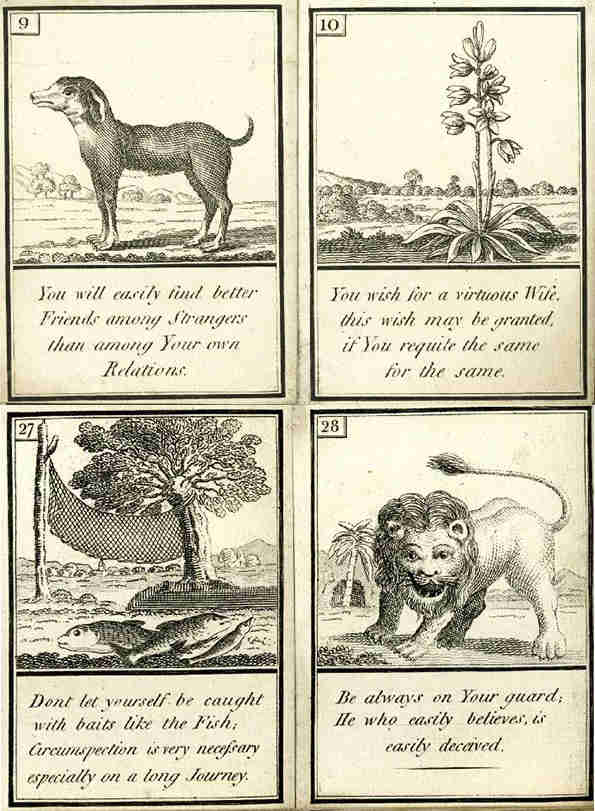
Matthews has written several books on divination cards, and her latest work, The Complete Guide to Lenormand Oracle Cards, was published in October 2014. This 36-card deck is named after the famous card reader Mademoiselle Marie Anne Lenormand, who was popular in the eighteenth and early nineteenth centuries, though the deck bearing her name was not created until after her death. The oldest in Matthews’s collection are two Lenormand-style decks: the Daveluy deck from 1860s France and the 1864 Vienna Zauberkarten deck, which were among the earliest decks to use color lithography.
Compared with traditional tarot, divination decks like Lenormand tend to use a more direct visual language. “Tarot can often describe our place in the world in a broad, timeless, universal language,” Wolf says. “The imagery of divination cards is more intuitive, with fewer archetypes. These images are usually more specific, simpler, and less universal, making the conversation more direct.”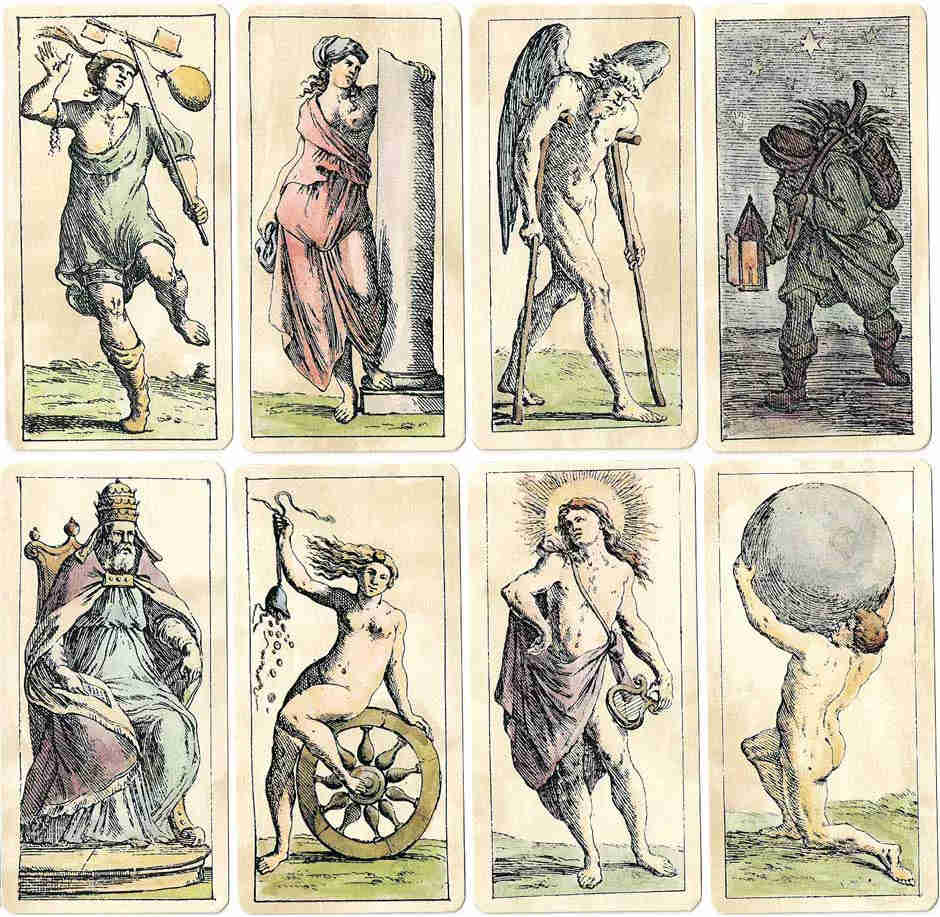
Unlike most divination decks, which lack a suit of minor cards, Lenormand cards feature a distinctive combination of numbered playing-card imagery layered onto illustrated scenes used for divination. “One of the earliest versions, called ‘The Game of Hope,’ was a bit like a board game, created by a German named J.K. Hechtel,” Matthews says. “You lay out cards 1 through 36, and the goal of the game is to roll the dice and move your own token. If you reach card 35, the Anchor card, then you’ve made it home safely. But if you go past this card, that’s the Crossroads, and it’s not so good. It’s a bit like Snakes and Ladders.” And so “The Game of Hope” entered the Victorian tradition of tabletop board and card games, in which a player’s life story is determined by luck.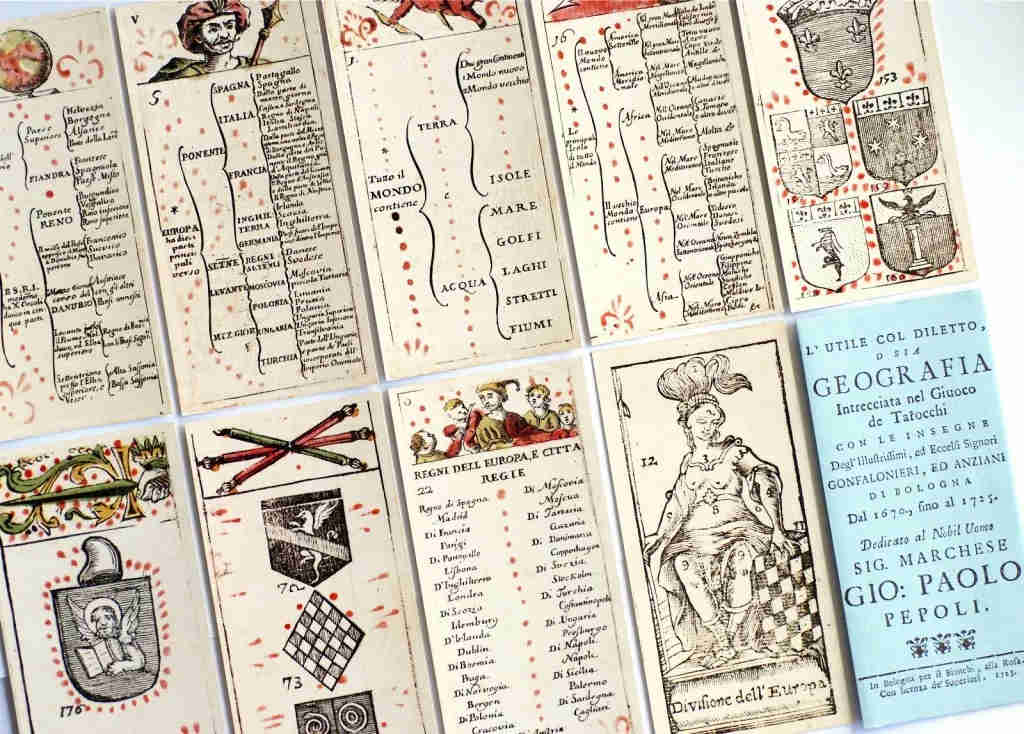
Comment
11 classic spreads with instant upright & reversed love, career, and clarity readings.
Searchable guide to Major & Minor Arcana symbolism, keywords, and crystal pairings.
Instant visual chakra map and mindful crystal suggestions — no email required.
Handpicked quartz bracelets, orgone pyramids, and altar supplies for daily rituals.