Can Tarot Cards Really Predict Your Fate? The Enigmatic Origins of Tarot (Part 1)
Jan 11,2022 | 魔法塔羅的朋友們
The Tarot Cards That Foretold the Reagan Assassination Attempt
On March 30, 1981, Ronald Wilson Reagan—president for only 69 days—delivered a speech to a labor rally outside the Hilton Hotel. As the president finished his remarks and returned to his car, John Hinckley, a mentally ill man lurking among the onlookers, rushed forward and fired six shots at Reagan, who clutched his chest and fell. The scene seemed like a replay of President Lincoln's assassination, yet this president who created the Reagan era was fortunate enough to brush past death despite grave injuries.
When the news broke, the nation was stunned, because Reagan had broken the dreaded cycle known as the "twenty-year presidential death cycle"—the pattern in which every US president elected or reelected in a year ending in "0" died in office by accident. As for the miracle of the president's narrow escape, the First Lady attributed it to Joan Quigley, believing that this female seer, skilled in Tarot Reading and astrology, had foreseen and warned in advance, prompting the president to be especially careful that day and avert disaster. Quigley herself said bluntly: "It was the guidance of the Tarot spirits that allowed me to foresee this."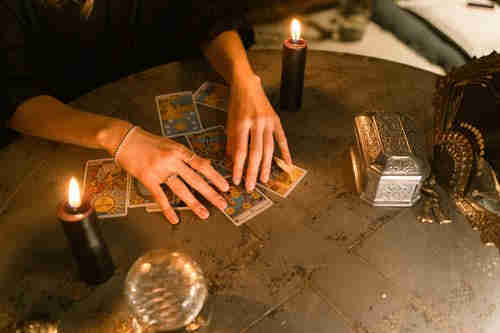
The "Tarot spirits" the seer spoke of refer precisely to the Tarot cards: a legendary system passed down for a thousand years, one of the three great divinatory arts of Western esotericism alongside astrology and numerology.
An Elusive Origin
Anyone today who intends to study Western esotericism shares a basic understanding: one must study Tarot, astrology, and numerology together, for only under these three complementary disciplines can one enter the door and glimpse the wonders of Western esoteric teachings. Among these three arts, the Tarot possesses both artistic beauty and mystery—it can be used for divination and also appreciated and collected as art—which is why it is the most widely circulated and has the largest following. Yet the origin of the Tarot alone remains disputed and undetermined to this day.
Legend holds that Tarot is the Egyptian "Royal Road" book. The word derives from the Egyptian Tar (road or law) and Ro (king or emperor); it was originally painted on temple murals to convey the will of the gods and answer the pharaoh's questions. Because it was too bulky, it was later drawn into a book for the pharaoh's convenience. This sole volume, which only the pharaoh could possess, was a book of wisdom for communing with the gods when affairs of state were in doubt—and anyone who peeked at it would face the death penalty.
A major piece of evidence for the theory that Tarot originated in China is that the cards themselves are made of paper. It is said that the Tang dynasty monk Yixing, the world's earliest measurer of the meridian, invented a paper card game called "leaf game," which became widely popular in both the court and among common people. Scholars who support the Chinese origin of Tarot believe that the practice of painting different figures and suits on exquisitely made cards in the leaf game is a trace inherited by the Tarot. The ancient Chinese dialectic of "fortune and misfortune depending on each other" also happens to align with the Tarot's sharply different Upright and Reversed interpretations.
In Hebrew, Tarot represents law. The 19th-century occultist Lévi linked the Tarot with the ancient Jewish mystical tradition of Kabbalah. The correspondence between the 22 letters of the Hebrew alphabet and the Tarot, as well as the correspondence between the 22 paths of the Kabbalistic "Tree of Life" and the Major Arcana of the Tarot, gave great confidence to supporters of the Hebrew origin theory.
Wherever it originated, the Tarot began its thousand-year journey alongside humanity's oldest civilizations—but that journey was not as smooth as one might imagine.

Passed Down Through Prohibition
The earliest surviving Tarot deck is a set of 17 "Major Arcana" cards held in the French National Library, said to have been made specifically for King Charles VI by the painter Jacquemin Gringonneur in 1392. Tarot cards recorded in legend appeared even earlier, at a German religious council in 1329. Three years later, King Alfonso XI of Spain issued the first declaration against Tarot cards. Soon after, the municipal government of Barcelona in France formally banned commoners from playing card games.
By the 14th century, the prohibition grew even stricter. In 1415, the Roman Catholic Church publicly banned card games. At a sermon in 1460, monks rigorously argued that the name and content of the Tarot were false and severely condemned those who played with them. Throughout the Middle Ages, the Tarot, like so many scientific truths, was placed on the church's list of heresies and was continually vilified and burned.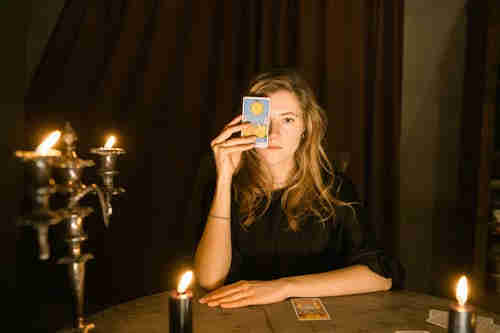
Under these circumstances, the Tarot went underground, preserved by secret sects regarded as heretical. In contrast to the church's severe prohibitions, the Tarot spread like a hidden fire creeping beneath the surface, appearing again and again. From a small game first circulated at the crossroads of Europe and Asia, it gradually flourished throughout the entire European world.
Records of the Tarot's transmission show: a painting created in 1450 was found at Issogne Castle in Italy, depicting eight soldiers and two women in an inn—the soldiers' weapons hung on racks on the wall, four soldiers on the left were playing chess, two soldiers and a woman on the right were fighting, and in the very center two soldiers and a woman were playing Tarot cards.
Disregard for the ban existed not only among the Italian upper class; even the ordinary citizens of Barcelona in France, where the ban was first issued, were enamored with Tarot cards, and by then the prohibition existed in name only. The reason Tarot won over the entire aristocratic world was not only its exquisite illustrations, scarce production, and gold-foil-and-jewel-inlaid exteriors—making it an excellent item for flaunting wealth and status—but also because the hints and interpretations of the mysterious language hidden within made it the best tool for passing secret messages among the nobility.
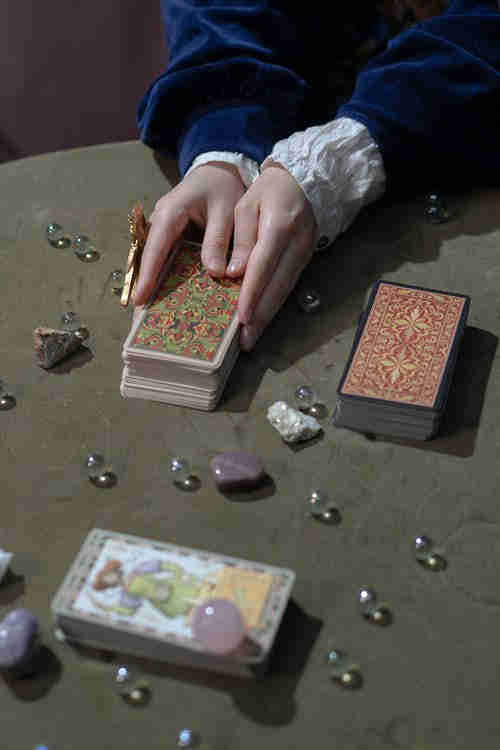
Through this covert transmission of interpretations, the Tarot began to be applied to divination and prediction, and it became distinguished from simple card games. Its mysterious predictive power, widely circulated among the common people, relied on the wandering of the Romani people. Making their living as nomads through acrobatics and divination, their main divination tools were Tarot cards and crystal balls. Thus, in the many legends about the Romani, the Tarot also took its place in people's minds as this mysterious instrument.
At this point, printing technology entered Europe and matured in the 16th century. The once-expensive Tarot cards were printed in large quantities, and the last barrier to the Tarot's popularization disappeared. More and more scholars began to grow curious about it, and deeper theoretical systems concerning the Tarot were established—only then did the Tarot reappear before the world in an entirely new form.
Comment
11 classic spreads with instant upright & reversed love, career, and clarity readings.
Searchable guide to Major & Minor Arcana symbolism, keywords, and crystal pairings.
Instant visual chakra map and mindful crystal suggestions — no email required.
Handpicked quartz bracelets, orgone pyramids, and altar supplies for daily rituals.